Month ends and leap-day birthdays: choose a convention
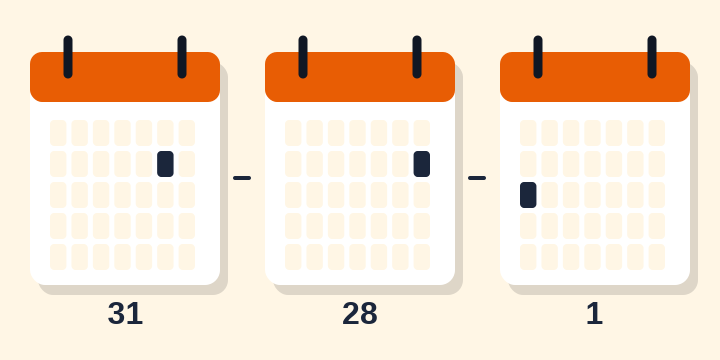
January 31 has no matching day in February. That is why two age calculators can disagree about the number of months. I check their month-end rules first, then compare the total days and the dates behind each result.
What happens when my birth day is missing from a month?
The calculator uses an anchored month rule. Keep the day number when it exists in the destination month; otherwise use that month’s last day. January’s final day plus one month lands on February’s final day. In a common year that is the twenty-eighth day; in a leap year it is the twenty-ninth. March’s final day plus one month similarly lands on April’s thirtieth day.
Anchored addition is direct from its starting anchor. It does not mutate that anchor while passing through an intermediate shorter month. January’s final day plus two months lands on March’s final day. Adding one clamped month and then another from the shortened February date can land earlier. These are two different operations, so the tool uses the direct one consistently.
I look for this distinction when reviewing an age calculation. A result that merely says “one month” does not tell you how the missing day was handled. The calculation table gives the actual month anchor. If another procedure requires borrowing rather than clamping, use that procedure and compare its intermediate dates, not just the final digits.
How do I calculate age in years, months and days?
The first step finds the most recent completed anniversary of the original start date. That date is the year anchor. The next step adds anchored months from the year anchor, choosing the largest count below twelve that does not exceed the reference date. The last step counts calendar days from that month anchor to the endpoint.
This order matters because a year anniversary and twelve sequential clamped-month operations need not preserve the same day. The tool does not build completed years by repeating a month addition twelve times. It checks anniversaries directly, including the selected leap-day rule. The remaining month count is therefore a component of that ordered breakdown, not an independent measure of all whole months since birth.
For a same-year interval from January’s final day to March’s first day in a common year, no full year fits. One anchored month reaches February’s last day. One more calendar day reaches March’s first day. The result is zero years, one month and one day, with twenty-nine total calendar days. A single previous-month borrow can produce a negative remaining-day value here, which is a useful warning sign.
| Starting day and endpoint | Anchor selected | Remaining days |
|---|---|---|
| January 31 → February 28, common year | February 28 | 0 |
| January 31 → March 1, common year | February 28 | 1 |
| January 31 → March 1, leap year | February 29 | 1 |
| March 31 → April 30 | April 30 | 0 |
When do February 29 birthdays fall in a non-leap year?
February 29 exists only in leap years. A common-year anniversary needs a convention if you want to count completed birthday years or display the next birthday. The tool offers February 28 and March 1. I keep the choice visible because a hidden default can explain a full-year difference near the end of February.
At February’s last day in the common year immediately after a leap-day birth, the February 28 option completes one year. The March 1 option waits until the following date. Before that date, this calculator shows zero years, eleven months and thirty days under its ordered month rule. The original start and reference dates have not changed, so the total calendar-day count is identical under both options.
When the reference year is itself a leap year, both choices use the real February 29. The February 28 option does not permanently move the birth date a day earlier. Similarly, March 1 is only the substitute in a common year, not the birthday in every year. Keeping the original birth date intact is essential for exact day counting.
Which birthday rule applies to an official age calculation?
The choice here is a general calculation convention. A legal jurisdiction, school system or assessment publisher may define age differently for a particular purpose. The calculator does not decide which rule governs your case. I would check the relevant authority before using any result to determine eligibility, filing status or a clinical age band.
There is also no rounding of remaining days into a new month. A display with thirty remaining days may look unusual beside a month count, but it can follow from a leap-day year anchor and an upcoming anniversary that does not share the same day. The reconstruction table is the stronger check: adding the reported steps must reach the original endpoint.
For comparing two calculations, keep both original dates visible. Changing the anniversary rule changes the breakdown around a leap-day birthday, but leaves the day total unchanged. That gives you a useful first check: if the day totals differ too, check whether the reference dates or inclusive-count settings differ.
What do the birthday countdown and progress ring mean?
The next birthday includes the reference date itself. On the selected anniversary, the card says Birthday today and has zero days remaining. It does not skip straight to the next year simply because the two dates are equal. The following day, it points to the next anniversary. That makes a birthday-day result useful rather than unexpectedly showing a nearly full-year countdown.
The ring measures progress through the current birthday year. It starts at zero on an anniversary, then divides the civil days since that anniversary by the number of civil days until the following one. Depending on where leap day falls, that interval may have a different length. The next-birthday card and ring need not show complementary values on the birthday itself because the countdown is inclusive of today.
I read the caption beneath the diagram alongside the percentage. It gives the days completed and the length of the current birthday year, so you can check the ring without estimating its shaded arc. If the next anniversary would exceed the supported range, the tool reports that limitation.
Why do age calculators give different month-end results?
Start with the original birth or start date. Then compare the completed-year anchor. If that differs, check the February 29 choice and the reference date. If the year anchors match but the month counts differ, compare the month-addition convention. Finally, count days from each month anchor to the endpoint and verify that the reported remainder rebuilds the reference date.
The Gregorian leap-year rule from the US Naval Observatory governs the calendar lengths used here. The chosen common-year birthday convention is a separate setting in this tool, not a claim that the Observatory prescribes a personal anniversary rule. That separation keeps the source attribution honest.
Use the calculator to copy the dates, convention and result together. The CSV also includes the year and month anchors. If the question only asks for elapsed calendar days, the day-count guide gives the simpler interpretation. If it asks for age at a particular event, confirm the fixed reference date before investigating month arithmetic.
Quick answers
Is January 31 to February 28 a full month?
In a common year, this tool treats it as one anchored month with zero remaining days. A method that requires the same day number may give a different month component. Compare conventions before comparing results.
Why can the result have thirty remaining days?
The month count is limited to eleven after the last completed anniversary. For a leap-day birth with the March 1 rule, the day before the first common-year anniversary gives zero years, eleven months and thirty days. The displayed dates reconstruct the result.
Does choosing March 1 change my total days?
No. It changes completed anniversaries, the birthday countdown and the year/month/day breakdown. The original birth date and reference date stay the same, so their calendar-day difference stays the same.